

By Nancy Parsons
When we started our firm in the late 90s, we used the tag line “You can’t teach fish to fly.” The notion that you can train anyone to lead well, or that you can teach anyone to become a scientist or great novelist is simply untrue. Trying to train or teach a skill that is beyond an individual’s natural capability can be costly and futile. The failure to identify, deploy and develop people most effectively, is imperative, and it begins with understanding an individual’s authentic capability.
At the the HR Technology Conference and Expo in October, 2022, Jason Averbook CEO of Leapgen commented in the closing speech, “When we think about transformation, one of the things that’s so important is we are all transformation agents, whether we like it or not.” (Quoted in HR Executive article by Nick Otto.) While HR transformation is a must for the future, currently it is not plausible based on contrary to the personality character profiles of most HR leaders.
In my article, “Why the Normal HR Playbook Won’t Work to Meet Steep Challenges Ahead and What to Do About It,” I wrote,
“The truth is that most HR leaders do not have change agent profiles. Our data show that most established HR types tend to be risk aversive. HR people tend to be great at processes, operations, policy administration and guidance, implementing and getting things done well with consistency. They are practical, helpful, and relatable. However, those relying on the existing HR playbook and who are not comfortable with change, will not be prepared for the new world challenges.”[1]
Of course, there are innovators and change agents in the mix, but the command-and-control, risk aversive profile dominates HR leadership today. There is important preparation work needed to understand the true talent distribution of HR teams in order to make way for transformational success.
In Otto’s article “10 Skills for HR leaders to Transform in 2023 and Beyond [2] in HR Executive, he articulates well the skills essential to transformation which include:
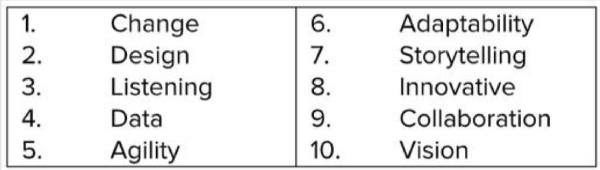
Unfortunately, there are only three to four skills on Otto’s list that the typical HR leader will be able to adopt readily: listening, storytelling, agility and possibly data.
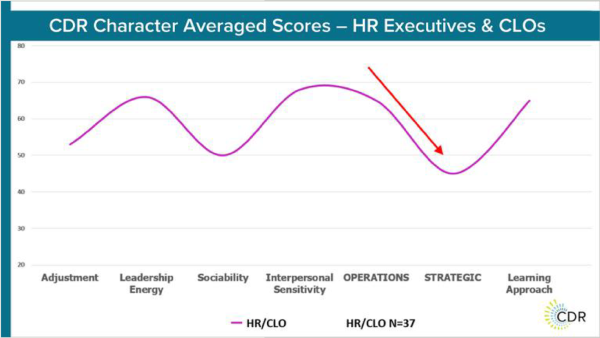
Below in Illustration 1 is the typical profile personality characteristics of HR Executives (including Chief Learning Officers), and you can see that they are clearly not change agents.
Illustration 1.
So, what should HR leaders do to equip themselves and their teams for the essential transformation? Here are a couple of suggestions:
1) Hire a consultant to accurately assess you and your team (with scientifically validated measures including a Five Factor Model instrument) to get a clear reading on your capabilities, strengths, gaps, risks and passions/motivation.
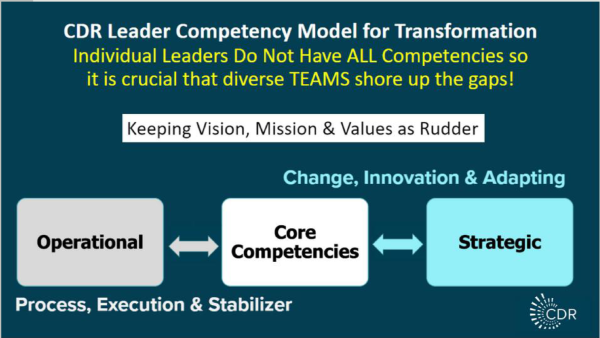
a. Ascertain who on the HR Team has strengths as innovators, change agents and those who have operations and administrative capabilities. You need both and a diverse array of team competencies. In Illustration 2, there are clear leader competencies for both strategic and operational profiles, in addition to the base line leadership core competencies. Most leaders and individuals have strengths more predominately in either operational or strategic. As shown above in Illustration 1, HR leaders tend to have the operational traits.
Illustration 2
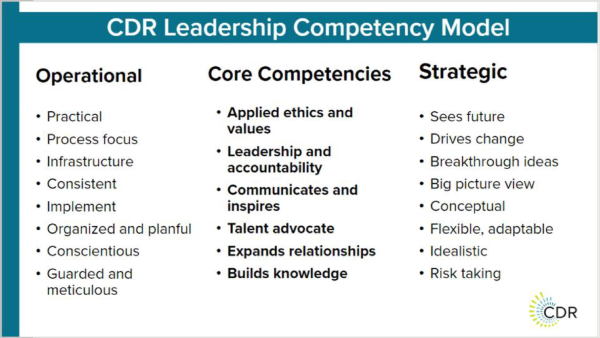
Illustration 3 shows that to be successful with change and transformation, both capabilities of innovators and operators are needed. Innovators are adept at creating ideas for change and to adapt to the future, but they need to be reviewed with and implemented by the operational types.
Illustration 3.
2) Have a consultant conduct a team session to review team results. Before the team session, provide an individual coaching debrief with each team member with their own assessment results so that each member is fully self-aware of their own profile attributes. Then, share the team data to gain understanding of who is gifted at what, gaps, synergies, risks, passions, etc.
3) Discuss team profile trends. Is the team lopsided towards operations and being risk aversive? If so, what steps can be taken to shore this up? Is it possible to add team members, use consultants, transfer those with strategic innovative profiles into HR, etc.?
4) Build in safeguards to prevent the command-and-control operational leaders from shooting down ideas before they have been fully formed or considered. Often, because these leaders are not comfortable with change, they thwart ideas early to resist new approaches. Try to clear the way and listen before finding flaws in the new ideas. Ask questions like how can we make this work? What are the benefits? How will these changes better prepare us for the future?
While it is essential that HR needs to move to a transformational mode as both Otto and Averbook suggest, it is important to measure HR talent profiles and take steps to ensure that there is sufficient bench strength balance to make the needed transformations happen. A “can do attitude” alone will fall short.
[1] Parsons, Nancy, CDR Companies, LLC, 01/22, https://www.cdr-u.com/news/why-the-normal- hr-playbook-won-t-work-to-meet-steep-challenges-ahead-what-to-do-about-it
[2] Otto, Nick, HR Executive, 09/22, https://hrexecutive.com/10-skills-for-hr-leaders-to- transform-in-2023-and-beyond/?oly_enc_id=0795J7399167H4E
Nancy Parsons is one of today’s foremost experts in combining the science of assessments with the art of developing people. As CEO & President of CDR Companies, LLC, she sheds new light on personality strengths, inherent risks and motivation and change performance, careers and lives. Nancy and her team developed CDR-U Coach, the first of its kind, Stevie Award winning digital avatar coaching platform so that personalized assessment and coaching feedback and development can now be provided to all levels of employees. She has presented for a variety of conferences, associations, companies and events. A short sampling includes: WGLC Women’s Global Leadership Conference, WBECS, ISPI, SHRM, ATD, Women In Energy, Women on Boards 50/50, MGMA, ACEC, OKCU, ISU, IE.edu and more. She has appeared on a variety of notable podcasts, radio and television interviews and hosts a monthly CDR Live on LinkedIn. She instructs executive coaches’ training and facilitates C-Suite executive team development sessions.