


By Nancy Parsons and Christine Klatt
Part 1
Businesses thrive on detailed inventories—they measure and value every aspect of operations, from maintenance and merchandise to sales, supplies, and work in progress. Inventories are the backbone of effective management.
Surprisingly, most businesses lack a ‘True Talent Inventory.’ They fail to measure the inherent capabilities and bench strength of their workforce. While some may track skills inventories, these fall short without first identifying and understanding the deeper capabilities, strengths, gifts, gaps, risks, and drivers of their people. Capability assessment must come first—only then can development efforts effectively align. Without detailed and accurate measures of their workforce, managing this critical asset becomes a hit-or-miss endeavor, leaving potential untapped and risks unaddressed. This results in:
- Employees being placed in the wrong jobs
- Untapped hidden potential
- Ineffective costly training
- Diminished leadership and lackluster performance
- Unbalanced or homogenous teams that fail
- Low employee engagement
- Unaddressed risks causing ineffectiveness
Unfortunately, the misses are staggering:
- For decades, studies have consistently shown that 50% to 75% of leaders are ineffective, with a multitude of factors contributing to this alarming statistic.
- The Global Leadership Forecast 2023 – surveying over 15,000 leaders and HR professionals in more than 50 countries – revealed that only 12% of companies are confident in the strength of their leader bench.¹
- Leader failures are estimated to cost businesses $450 to $550 billion per year. ²
- Despite $46 billion spent globally on leadership development programs (Deloitte), data from the Corporate Leadership Council indicates that these efforts have only improved productivity by a mere 2%.³
- Companies fail to choose the right talent for management positions 82% of the time according to Gallup.⁴
- Additionally, Gallup reports that 77% of employees are disengaged.⁵
There are more studies – but clearly, significant work is needed to improve leadership and performance overall. Perhaps more paramount than the toll of the problematic performance is that organizational leaders, especially HR, ignore this issue. For too long, the people side of the business has been dismissed as too nebulous, tedious, messy, and troublesome for executives to manage effectively.
“Every time over the last 25 years that I have been called in for an ‘intervention’ coaching assignment, the leader was in the wrong job the entire time as diagnosed by the assessments,” explains Nancy Parsons. Yet, organizations put up with problematic behaviors due to the incumbents’ technical expertise or due to customer knowledge, etc. Meanwhile, their constant failures are tolerated while complaints, abuse, and turnover may be rampant.
This reluctance to act is compounded by the fact that many senior leaders come from STEM or financial backgrounds where their strengths lie in analyzing hard data, numbers, and measurable outcomes—not in navigating the complexities of dealing with people effectively. Addressing these gaps requires a shift in mindset and a commitment to valuing and developing the human capital that drives organizational success, starting with using good scientifically validated data.
Unfortunately, the HR and talent development experts have not dealt with this issue directly either. This is because most HR leaders and staff do not inherently have change agent profiles. Our data show that most established HR professionals tend to be risk aversive and great at processes, operations, policy administration, implementing and getting things done well with consistency. They are practical, helpful, and relatable. However, most are not comfortable with change and this talent performance issue may seem overwhelming.⁶
Leaders who excel in analyzing data and measurable outcomes should naturally be drawn to a data-driven True Talent Inventory. By leveraging accurate, comprehensive insights into the inherent capabilities, strengths, gaps, and potential risks within their workforce, these leaders can approach talent management with the same precision and confidence they apply to financial forecasting or operational metrics.
A well-designed True Talent Inventory transforms the ‘people side’ of the business from a nebulous challenge into a strategic advantage. It provides actionable data that allows leaders to:
- Identify high-potential talent and align it with job requirements and business needs.
- Address capability and skill gaps proactively.
- Improve succession planning by building a robust leadership pipeline.
- Build and grow a diverse workforce by using objective data to reveal true talent that is not filtered out or overlooked due to common biases or traditional screening methods.
- Optimize development investments through personalized learning paths.
By grounding talent strategies in measurable outcomes, organizations can make smarter, evidence-based decisions about their most valuable asset: their people. This not only boosts engagement and productivity but also addresses the long-standing leadership effectiveness crisis.
In short, a data-driven True Talent Inventory is the key to unlocking both individual and organizational potential.
By using scientifically validated, in-depth assessments such as the CDR 3-Dimenional Assessment Suite, also referred to as the True Talent ProfileTM, you can get the people side right and stop placing or promoting people into roles that do not match their inherent strengths and drivers.
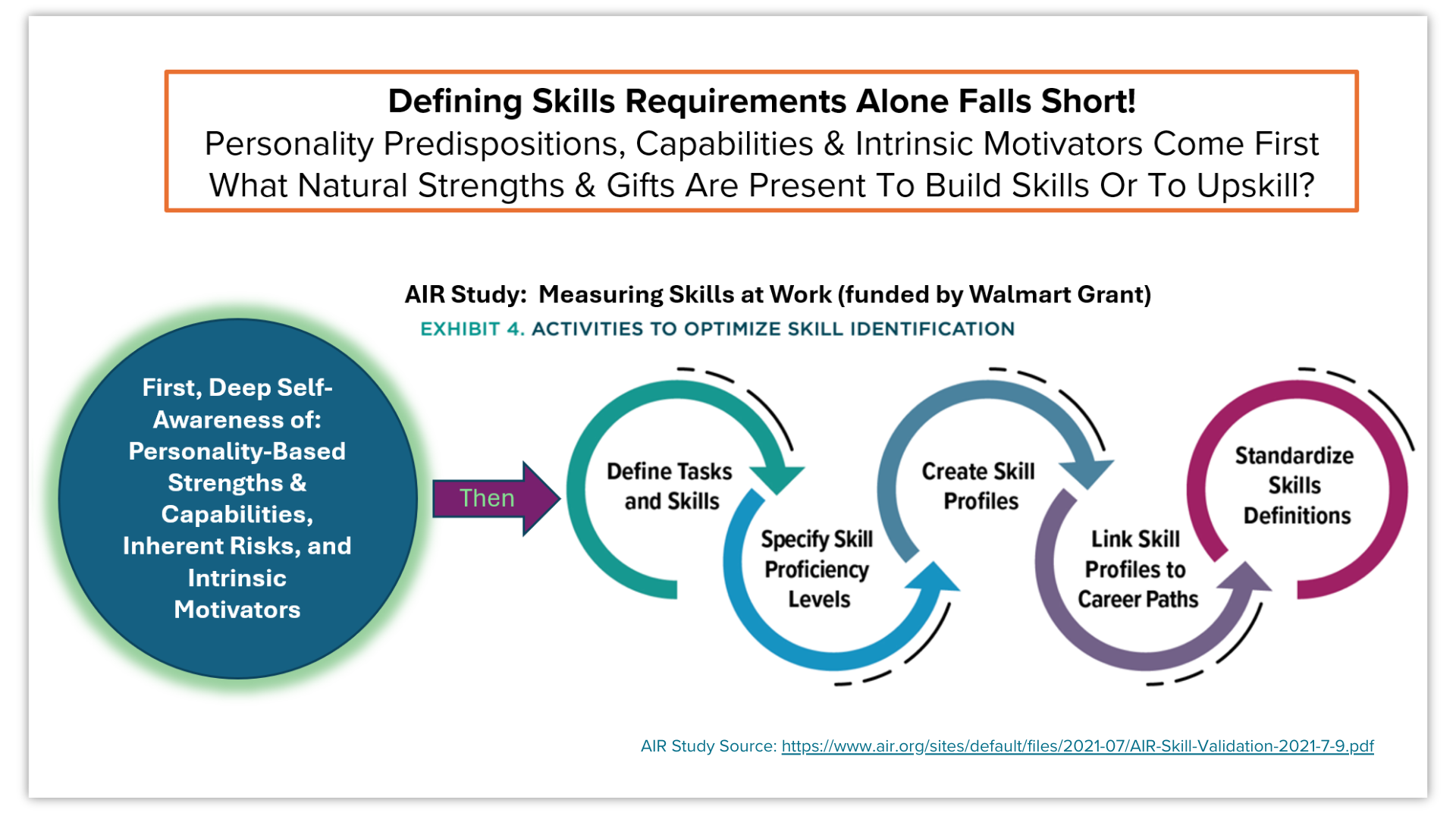
Capabilities versus Skills Inventories Illustration
Below is an illustration of an actual Skills Inventory of an AIIR Study funded by a Walmart Grant. As shown, without first identifying one’s inherent capability (added to the left), this skills inventory falls short and misses quite a bit of natural hidden or underdeveloped talent.
What is a True Talent Inventory? See Article Part 2
In order to learn more about what a True Talent Inventory measures, stay tuned for the upcoming True Talent Inventory Article Part 2.
If you wish to be notified when this is published, click here: Sign Up Here
¹ https://www.ddiworld.com/global-leadership-forecast-2023#
² https://news.gallup.com/businessjournal/162953/tackle-employees-stagnating-engagement.aspx
³ Source: How Much Does Bad Leadership Cost An Organization? – Best Practice. pdf, Best Practice Certification, Ptd. Ltd. 2023
⁵ Gallup State of Workplace https://www.gallup.com/workplace/349484/state-of-the-global-workplace-2022-report.aspx
⁶ Parsons, Nancy, CDR Companies, LLC, 01/22, https://www.cdr-u.com/news/why-the-normal-hr-playbook-won-t-work-to-meet-steep-challenges-ahead-what-to-do-about-it